
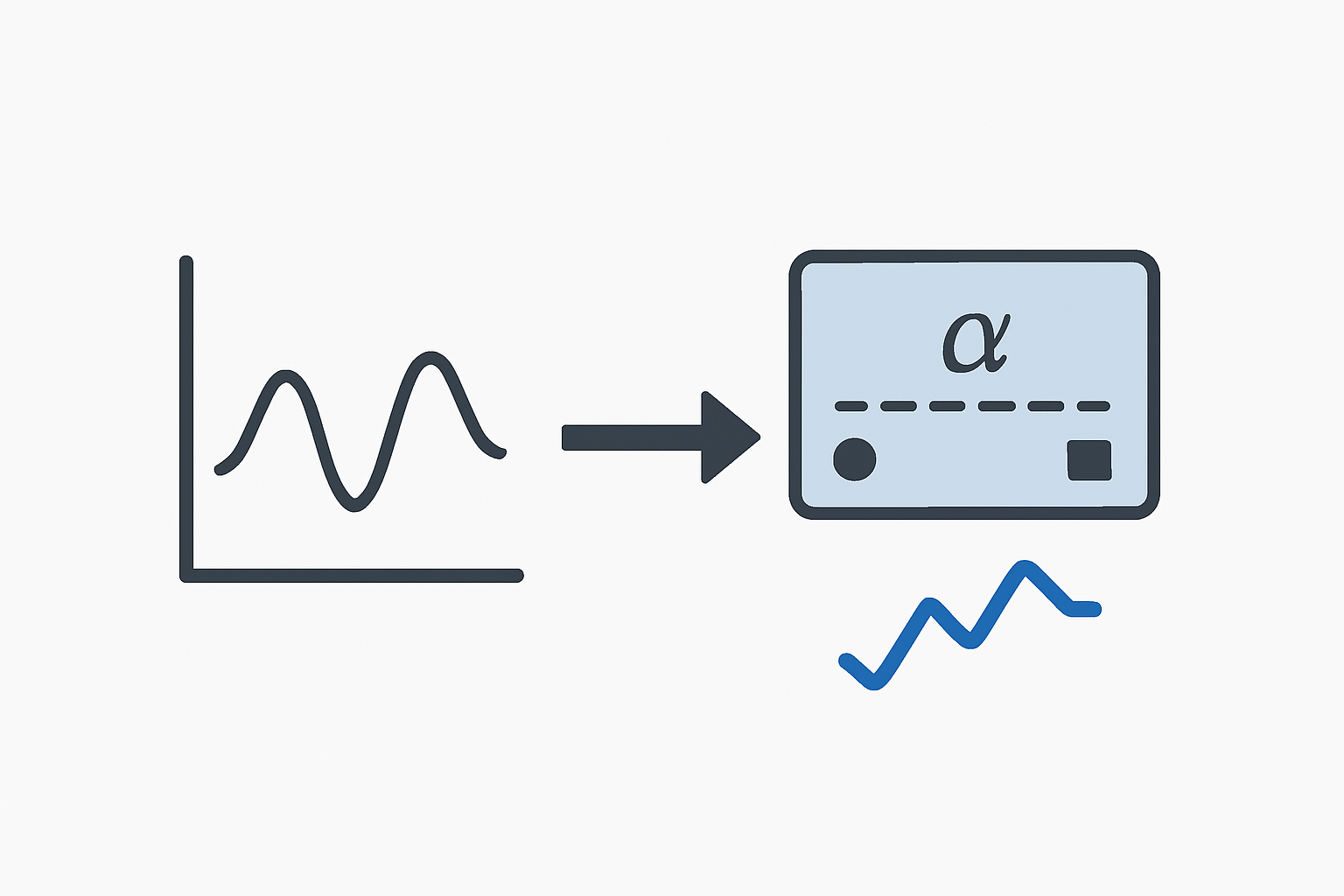
Introduction — what is a fractional-order model?
A fractional-order model uses derivatives and/or integrals of non-integer order (for example D0.7x(t)) to describe system dynamics. Mathematically these operators introduce memory: the system’s present depends on a weighted history of past states, not only on finitely many derivatives. This extra modelling flexibility often matches the physics of diffusion, viscoelasticity and anomalous transport better than integer-order models. Surveys of the field detail both the mathematical basis and a wide range of applications.
What fractional models tell us about real processes
- Processes have memory. Fractional models quantify long-range memory and hereditary effects (for example in thermal diffusion, viscoelastic materials, electrochemical systems). When a fractional model fits better than an integer model, that indicates the plant’s dynamics are not local in time — past inputs and states exert a slowly decaying influence.
- Slower-than-exponential responses. Fractional dynamics often produce power-law decay or other non-exponential transients; recognising this helps avoid over-simplistic controller designs that expect purely exponential settling.
- Effective low-order descriptions of complex physics. Fractional operators can compactly represent complex internal dynamics (microstructural damping, diffusion heterogeneity) with fewer parameters than a high-order integer model, making them attractive for model-based control if identified robustly.
(These are not purely theoretical curiosities — engineers have applied fractional models in heat transfer, electrochemical battery models, viscoelastic damping and control-oriented identification.)
Key practical example from the literature (Burnham et al.)
Allafi, Zajic, Uddin and Burnham (IET CTA, 2017) developed parameter-estimation methods for fractional-order Hammerstein–Wiener models, demonstrating a practical route to identify fractional dynamics from noisy input–output data. Their work shows fractional models can be identified with extensions of instrumental variable methods and that these models can improve fit for processes with input-dependent nonlinearities. This is a concrete example where fractional modelling led directly to better, implementable system descriptions.
Identification — how to obtain fractional models in practice
Frequency-domain fits: fractional models often show characteristic power-law behaviour in frequency response; fitting magnitude/phase over frequency can reveal fractional orders.
Time-domain methods: extended RIV (refined instrumental variable) and BE (best-estimate) type methods have been adapted to fractional continuous-time models; Burnham et al. extend RIV approaches for Hammerstein–Wiener structures.
Regularisation & model order selection: fractional models are powerful and can over-fit; use cross-validation, regularisation and physically informed constraints (e.g. causality, passivity) when estimating parameters.
Control strategies using fractional models
Fractional-order controllers (FOPID): controllers with fractional integrator/derivative terms (PI^λD^µ) provide extra tuning knobs to shape phase and magnitude over a broader band than integer PID; several surveys and studies summarise tuning rules and practical realisations.
Model-based control: where a fractional plant model is identified, model-predictive or state-feedback controllers can be adapted to the fractional dynamics (often via discretisation or approximations like Oustaloup filters). Use approximations that preserve the low-frequency memory behaviour you care about.
Robust design: fractional models may better expose slow modes or long memory that affect stability margins; include robustification (gain/phase margins, H∞ methods) when moving to product readiness.
Implementation notes — approximations and numerical realisation
Approximate the fractional operator: in practice you implement fractional derivatives via rational approximations (for example Oustaloup filters) or finite-memory discrete approximations. Approximations must be chosen to cover the frequency band of interest and be tested for numerical conditioning.
Computation vs fidelity trade-off: richer fractional representations improve fidelity but increase computational burden; aim for the simplest fractional structure that captures the essential memory features for control.
When fractional models help most — rule of thumb
Choose a fractional model when:
- residuals from integer-order identification show long-range correlation or power-law decay; or
- system physics suggests diffusion / viscoelastic / porous media behaviour; or
- a low-order fractional model explains broad-band behaviour that would otherwise need many integer poles/zeros.
Pitfalls and cautions
Over-fitting & interpretation: a better numerical fit does not automatically imply correct physics — validate fractional models with cross-validation and physical reasoning.
Numerical issues: approximations for fractional operators can introduce phase error or poorly conditioned filters at band edges — test across the expected operating envelope.
Certification and explainability: in safety-critical industries, fractional models can be unfamiliar — provide clear validation evidence and simpler fallback controllers where needed.
Practical roadmap for an engineering pilot
Run exploratory identification with both integer and fractional candidate structures; look for power-law residues and better cross-validated error with fractional fits.
Use physically informed constraints to reduce parameter uncertainty (for example enforce passivity or known asymptotics).
Approximate fractional operators (Oustaloup or other rational approximations) tuned to your frequency band. Validate the approximation in HIL.
Design controller with robustness margins and staged tests (simulation → HIL → pilot plant).
Conclusion
Fractional-order models reveal the presence of memory, anomalous diffusion and long-tailed transients in many real processes. When properly identified and implemented, they give engineers a compact, physically meaningful way to capture dynamics that integer models miss — and Burnham and co-authors provide practical identification tools (for example for fractional Hammerstein–Wiener models) that bring fractional modelling closer to industrial practice. Use fractional models where physics or residual analysis indicates long memory, approximate operators carefully, and validate thoroughly before deployment.
Leave a Reply