
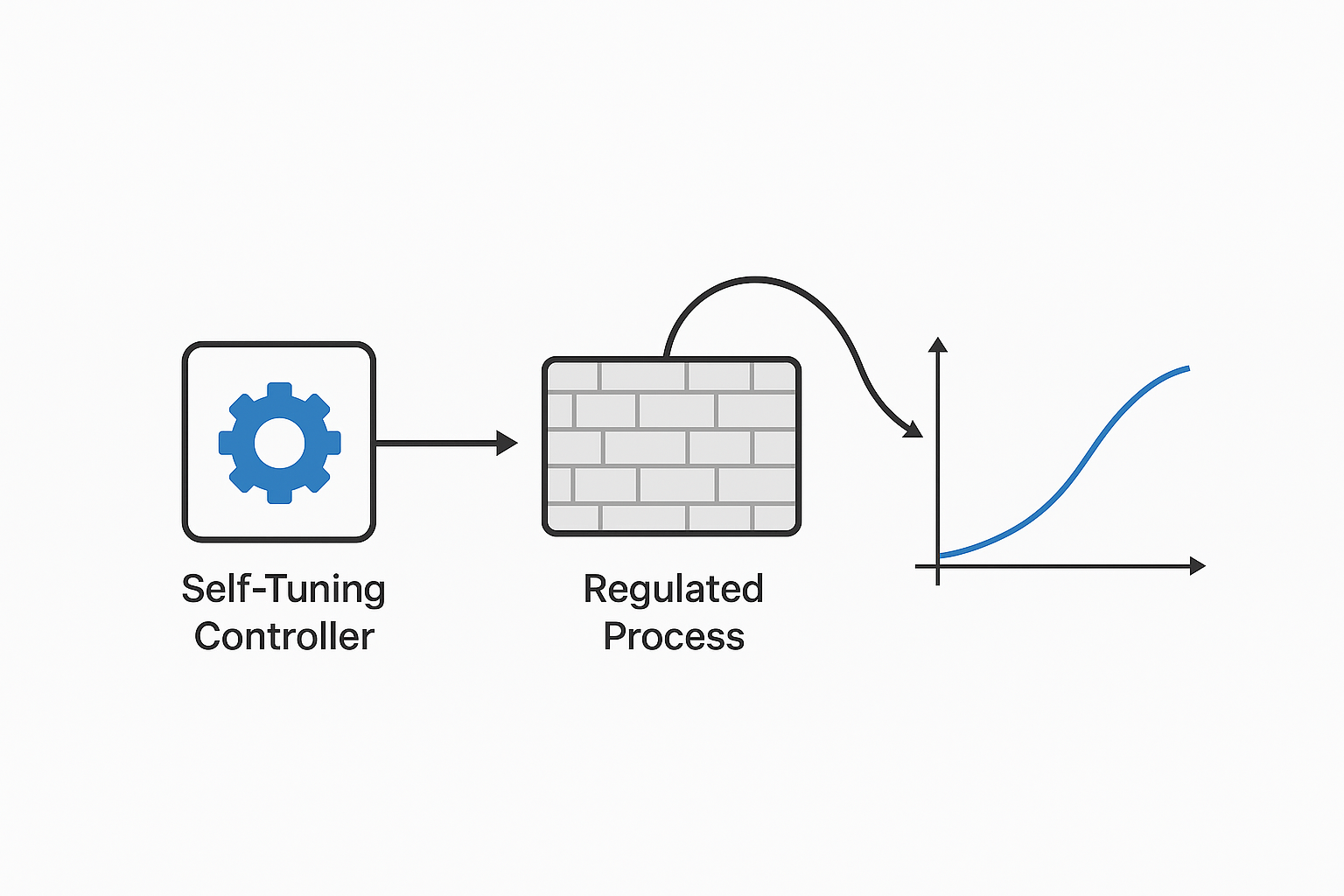
Introduction — what is self-tuning control?
Self-tuning control (also called adaptive control or self-adjusting control) is a class of techniques in which the controller updates its own parameters online. Instead of designing a fixed PID or state-feedback for one “nominal” operating point, a self-tuning controller estimates relevant plant parameters (or the plant model itself) and adjusts its control law so performance remains acceptable as conditions change. This reduces the need for manual retuning and can improve robustness to ageing, load changes and nonlinearities.
Why industry should care
Less manual tuning: Plants that change (different products, wear, environmental shifts) need fewer scheduled tuning interventions.
Better yield and energy use: Maintaining tight control over changing processes can reduce rejects and energy consumption — critical in manufacturing and heat treatment.
Longer equipment life: By adapting to avoid persistent stresses or oscillations, adaptive controllers can reduce mechanical or thermal wear.
Burnham’s applied work includes surveys and case studies that show how self-tuning ideas moved from the lab into pilot and industrial environments.
One simple example: bilinear self-tuning control for a reheating furnace
This example is intentionally straightforward — it keeps the maths light while showing the practical idea.
The plant (in words)
A reheating furnace used in metal processing must keep slab temperature within a tight band. The plant dynamics change with operating point (e.g. load, fuel flow) and the effect of actuators is not strictly linear: heater input multiplies state terms — a situation well described by a bilinear model. Burnham and colleagues studied exactly this application in pilot-scale trials.
The idea (step by step)
- Model choice: approximate the furnace dynamics with a low-order bilinear model. Bilinear models are linear in the state if the input is fixed, but the input multiplies some state terms — they’re a simple way to capture input–dependent dynamics. dbc.wroc.pl
- Online parameter estimation: run a recursive estimator (for example a recursive least squares or extended least squares) to update the bilinear parameters as the furnace runs. Use a forgetting factor so the estimator tracks slow changes (e.g. fouling, fuel quality). Pure Portal
- Controller update: at each update instant, recompute the controller gains (for example a pole-placement or a model-based PID tuning rule) using the current parameter estimates. Apply the updated gains until the next estimate.
- Fallback & safety: if estimates become inconsistent (covariance blows up, residuals grow), revert to a conservative fixed-gain PID and alert operators. Burnham’s applied studies emphasise conservative fail-safe measures for industrial deployments. ScienceDirect
Why this is simple but powerful
- Using a bilinear model keeps computational cost low and matches the main nonlinearity of the furnace.
- Recursive estimation plus periodic controller recomputation is easy to implement on standard industrial PLCs or embedded controllers.
- The approach can demonstrably reduce temperature overshoot and energy use in pilot trials (see Burnham’s furnace study).
Practical checklist for a first pilot
Start small: use a pilot or testbed furnace, not the full production line.
Collect representative data: identify operating regimes and ensure the estimator sees examples of the dynamics you care about.
Choose conservative update rates: don’t update controller gains faster than the plant can respond; prefer smoothing.
Implement diagnostics: log residuals, parameter covariance and a simple health index; add a watchdog to revert to fixed control if needed.
HIL test before deployment: run hardware-in-the-loop tests with realistic noise and delays. Burnham’s industrial work stresses staged testing and operator buy-in.
Common pitfalls and how to avoid them
Over-confident initialisation: start with broad parameter covariances or conservative gains.
Insufficient excitation: if the plant stays at a single operating point, parameters cannot be identified reliably — schedule brief excitation tests or use fleet data.
Ignoring safety: always provide a predictable fallback controller and clear operator alarms.
Leave a Reply