
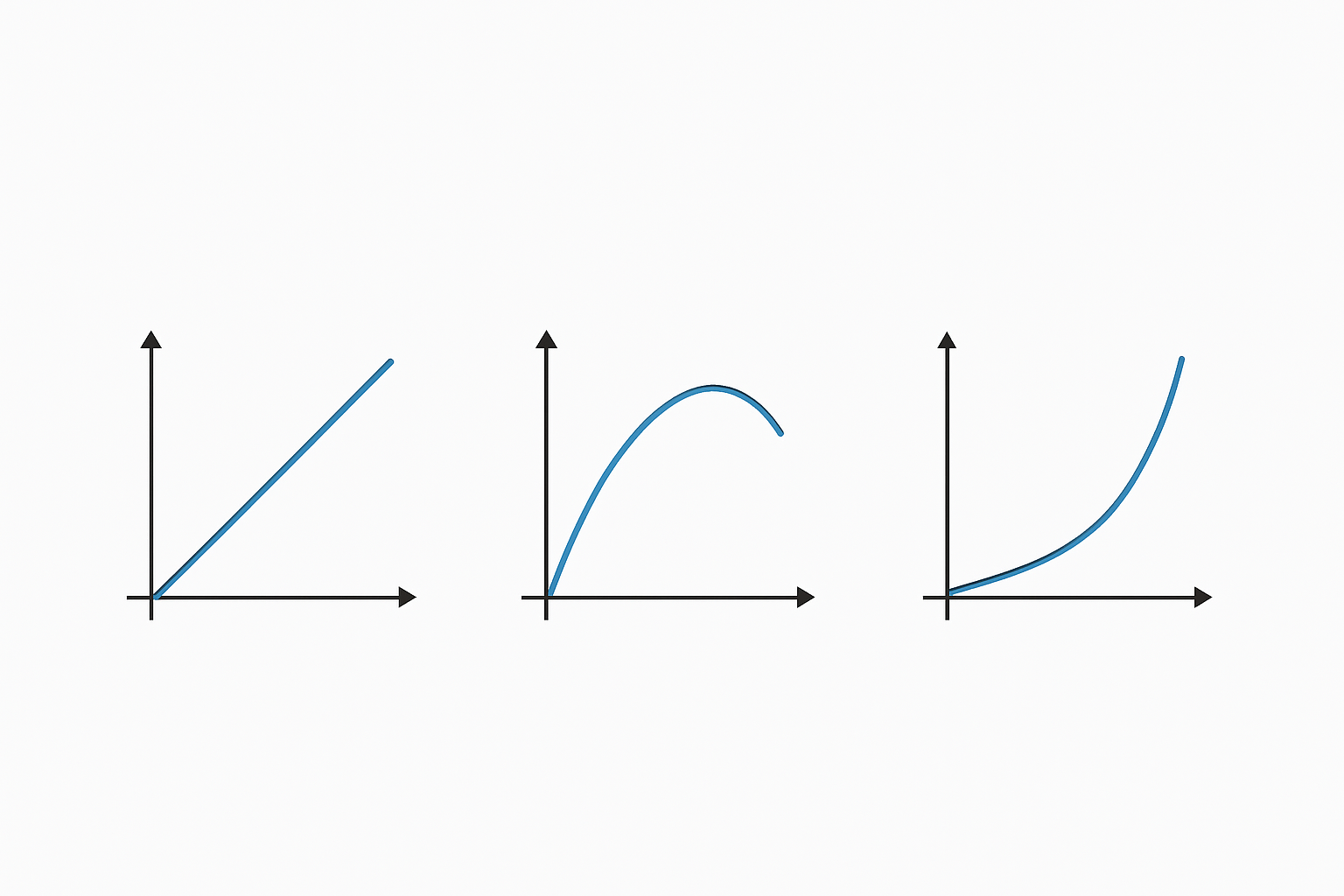
Introduction — what are bilinear systems?
A bilinear system is a special class of nonlinear system where the state equations are linear in the state for fixed inputs and linear in the input for fixed states; the nonlinearity arises from products of states and inputs. This structure makes bilinear models more expressive than linear models while keeping many mathematical tools (linearisation, observer design, pole assignment) usable with careful adaptation. Professor Keith J. Burnham’s PhD work and subsequent papers develop both the identification and self-tuning control approaches for bilinear systems and show their industrial relevance.
The “missing middle” — why bilinear matters
Linear models are simple and well understood, but often miss input-dependent dynamics seen in furnaces, chemical reactors and many electromechanical plants. Fully nonlinear models can be highly accurate but are often hard to identify, validate and certify for industrial use. Bilinear systems therefore occupy a practical “missing middle”: they are richer than linear models yet retain structure that makes control design and validation tractable.
To state it directly: The bilinear systems paradigm offers a natural methodological stepping stone between linear systems theory and practical real-world application. This procedural stepping stone provides an approach that leads to a bilinear systems modelling and control design framework, which is a widely applicable yet little known methodology. In short, bilinear modelling is a pragmatic route from neat theory to real products.
Where bilinear models are useful (industrial examples)
High-temperature furnaces and reheating lines: actuator effects multiply state terms (heat input × current temperature), a textbook bilinear situation — Burnham and Dunoyer demonstrated self-tuning bilinear control on a pilot furnace with better performance than a fixed PID.
Process units with input-dependent gains: certain chemical and thermal processes change gain with load and temperature; bilinear terms capture that behaviour without a fully nonlinear model.
Electromechanical devices: motors and power converters with input-dependent dynamics can sometimes be usefully approximated by bilinear maps, simplifying observer and controller design.
The pragmatic bilinear modelling & control framework
Use the following stepwise framework to move from data and physics to a deployable bilinear controller:
- Model selection: choose a low-order bilinear structure that captures the dominant input×state interactions (for example, a bilinear state-space model or a quasilinearised PIP variant). The aim is to hit the “sweet spot” — enough fidelity for control, few enough parameters for robust identification.
- Identification & estimation: apply recursive identification (e.g. extended recursive least squares with forgetting factors) tuned to the time-scale of parameter drift. Burnham’s research gives practical algorithms and bias compensation ideas for dynamical bilinear systems.
- Controller design: use bilinear-aware control laws (self-tuning pole-placement, bilinear PIP, or linear controllers scheduled with identified parameters). Where appropriate, compute controllable canonical forms to enable pole assignment and stabilisation—the controllable forms approach helps bridge theory and implementation.
- Validation: run HIL tests and pilot trials across operating regimes; check identifiability (persistency of excitation) and robustness margins.
- Operational safety: add diagnostics, conservative fallbacks and operator alarms so adaptation can be audited and, if necessary, halted.
It offers a straightforward pragmatic approach for designing control systems for practical industrial applications. That line of reasoning — from manageable model to verifiable controller — is precisely why bilinear methods are attractive to practitioners.
One simple example (sketch): bilinear PIP for a furnace
- Model: approximate the furnace with a low-order bilinear model where heater input multiplies a temperature-dependent heat transfer coefficient.
- Identification: run a recursive estimator with moderate forgetting to track coefficient changes as load and fuel vary.
- Controller: compute a PIP (proportional–integral with quasilinearisation) gain schedule from the current parameter estimates and apply smoothing between updates.
- Fallback: if residuals exceed a threshold, revert to a conservative PID and flag an operator alarm.
Burnham’s pilot-scale reheating furnace work offers a full worked example and shows energy and quality benefits when the bilinear controller is used in practice.
Practical tips for engineers
Keep the model low order. A compact bilinear model is easier to identify and to certify.
Test identifiability early. If the plant never excites parameter-sensitive modes, identifiability will fail — design short excitation tests or exploit fleet-level data.
Tune forgetting factors conservatively. Too aggressive tracking leads to jitter; too slow and you miss real drift.
Design for audibility. Log parameter estimates and residuals, and show them to operators — transparency builds trust.
Barriers and how to overcome them
Perception: bilinear methods are less well known than linear controllers; publish pilot results and simple case studies to build acceptance.
Skill gap: identification and bilinear controller synthesis require some specialised knowledge — pair controls engineers with academics or experienced consultants for the first pilot.
Legacy systems: use modular retrofit modules or gateway controllers so you do not have to replace the full control stack in day-one deployment. Burnham’s applied papers discuss staged rollouts and retrofit strategies.
Conclusion
Bilinear models provide a powerful, pragmatic middle ground for engineers who need more than linear theory but want to avoid the full complexity of general nonlinear design. The bilinear systems paradigm offers a natural methodological stepping stone between linear systems theory and practical real-world application. By following a straightforward bilinear modelling, identification and controller design framework — and by emphasising staged validation and operator transparency — teams can bring richer, more robust controllers into industrial products without excessive complexity.
Leave a Reply